

Happy Voskresen’ye, friends!


Three years ago, our college moved to a much smaller space, and the library could no longer hold its 107,000 print titles. We could bring only 13,000 with us. Ninety-four thousand books had to be eighty-sixed. Some dated back to the 1850s. It was painful. Those books gave our college weight, literally and figuratively.
The librarians were told to get rid of every book that hadn’t circulated in the previous five years. Faculty took some—not nearly as many as I thought they would. Staff took a few. A few hundred went to Better World Books, the Brooklyn Historical Society, and the Walt Whitman Society of Brooklyn. I dragged 400 books home and stacked them all over our apartment.
My wife told me that if I brought home another book, she’d have an affair with our dentist. At first, I thought it might not be such a bad idea. I was due for a crown, and he’d probably give me a discount if he were fooling around with my significant other. But then I realized that if I brought home any more books, the cockroaches wouldn’t have much room to run around. So I decided against it.
Eighty-seven thousand books were incinerated. The entire English department cried publicly. A group of psychology professors went on strike and held up a sign: “Fahrenheit 451 All Over Again!” But neither of them took a single book home.
Long story short, the other day I stumbled upon two of the titles I’d dragged home from the library: The Commissar Vanishes, by David King, and Photomontage, by Dawn Ades. The former is a horrific catalog of how Stalin’s regime used scalpels and airbrushes to erase political rivals from photographs. The latter is a history of artists who sliced, diced, glued, and mashed photographs together to protest the powers that be, i.e. bourgeois society.

One deals with subtraction as a tool of state terror. The other with addition as a tool of artistic and political rebellion. Two opposing forces using the same medium. Photographic manipulation for entirely different ends. Groovy. Drama. Dialectics.
The Commissar Vanishes is scarier than a Stephen King novel. Generals and no-longer-in-favor friends were purged from state records. The state manipulated photographs to induce amnesia in workers and peasants. What could be worse than killing a person? Killing the memory of a person.
“The physical eradication of Stalin’s political opponents at the hands of the secret police was swiftly followed by their obliteration from all forms of pictorial existence.”
—David King, The Commissar Vanishes
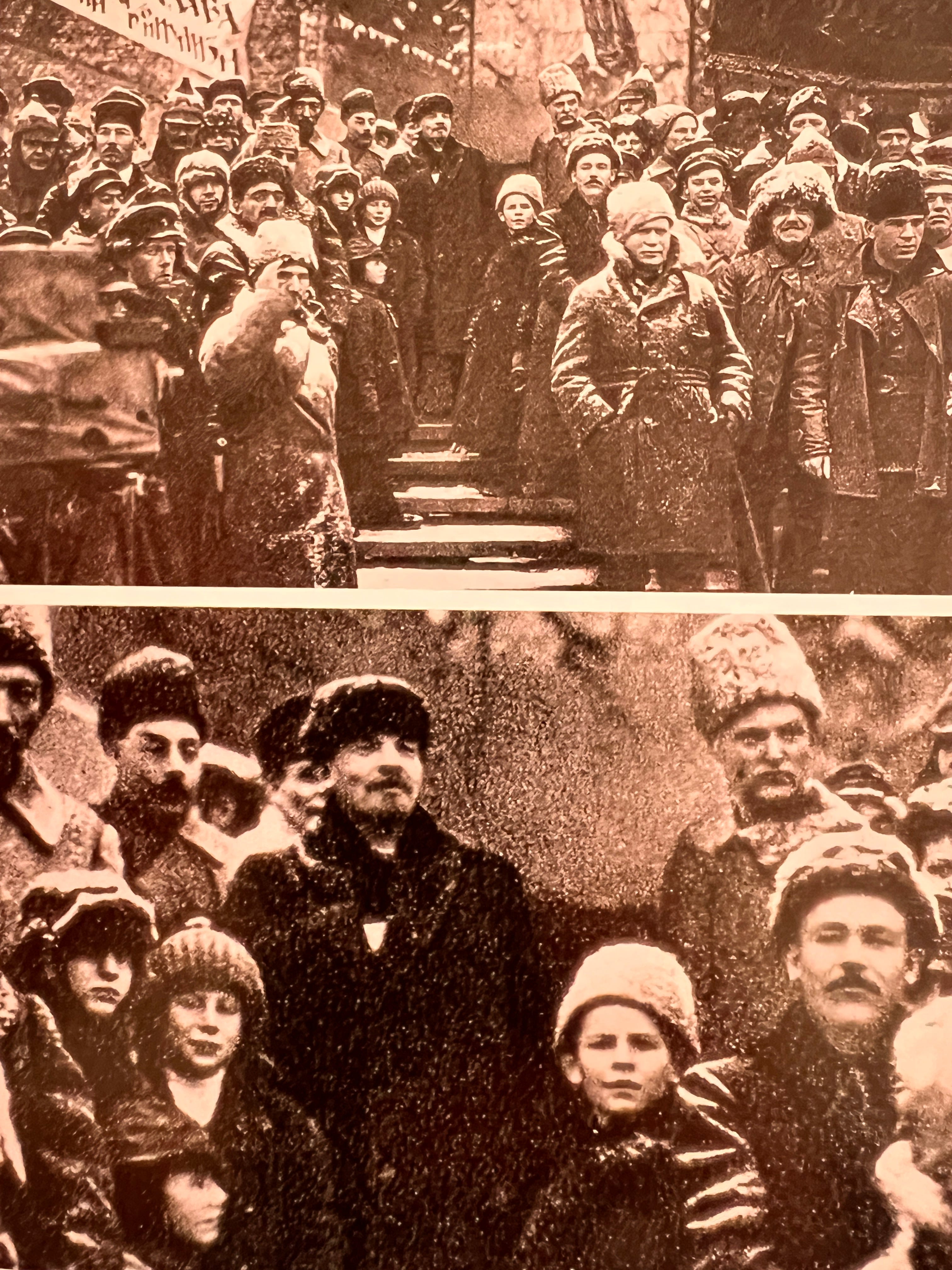


Photomontage looks at what happens when you combine photos to make a point. Instead of covering up reality, rebellious artists sliced up pictures and glued them together to force people to see the world in a new way.


“The fascinating paradox of being able to distort reality with the medium which is its truest mirror.”
—Dawn Ades, Photomontage
When you put these two books side by side, photography itself ends up on trial. For years people treated the camera as the ultimate truth teller. If you could see something in a photograph, it must have been real.

But Stalin’s censors and the cut-and-pasters of the 1920s understood photography differently. A photograph isn’t a fact. It’s raw material. By removing people from images to rewrite history, or combining images to promote or defend a revolution, they showed that a photograph is not simply a window onto reality, or worse, a mirror of life, but merely an interpretation, one shaped by a politician’s or an artist’s point of view.
The camera may capture a moment, but those in the darkroom decide what that moment will actually mean.

Two nights ago, I had a dream: A group of eager high school students from Ho Chi Minh City, Vietnam, who were writing an essay about Eastern European agriculture, contacted my friend in Marbella, Spain, and asked him to send me their urgent request: to put together a list of my favorite Van Morrison songs. I have no idea how they’d found out I was a big Van fan or how any of it was related to Second World agriculture, but I was flattered and honored. Here’s the list of songs I put together for the Vietnamese whippersnappers (quite different from all those Best Of… lists)
Sweet Thing (Astral Weeks)
Bulbs (Veedon Fleece)
Into the Mystic (Moondance)
T.B. Sheets (Blowing Your Mind -Live)
Sometimes I Feel Like a Motherless Child (Poetic Champions Compose)
No Religion (Days Like This)
So Quiet in Here (Enlightenment)
Got to Go Back (No Guru, No Method, No Teacher)
Bright Side of the Road (Into the Music)
Haven’t Lost My Sense of Wonder (Remembering Now)
**********************************************************************
Thanks for reading and being a subscriber.
’Till next time
ak

Great! And it is so hard to get good dentists these days but if you need one I have a great one and if it could save your marriage. . . As for Stalin, screw him.
A thought-provoking dichotomy. And now we've entered the era when deep-fake videos can lie about what animals do and what public figures have said and done, while the Dadaists in Iran make Lego Trump look an ass while those in Trump's circle use AI to send him up in a plane to dump feces on his enemies. So history continues, out of the darkroom and onto the hard drive, with more chaotic intent and a good deal less talent.
Regarding Van Morrison, a few years ago at the Hollywood Bowl I saw him. Tom Jones opened for him. It was a marriage of blue-eyed soul. And between Jones's solo set and Morrison's, Tom and Van together performed some beautiful, sparsely arranged blues standards including, morst memorable to me, "Trouble In Mind."